Sunday, May 31, 2015

Xan: Santa Fe Salad

Catherine loves Chop't, a sort of "Coldstone of salad" chain that is currently found only in DC and NYC. Because we do not currently live in either of those places, I modified a fine knockoff recipe of her favorite salad, the Santa Fe Salad.

Here is my version:


I like it a lot, but I have never had the real thing myself, so I rely on Catherine's evaluation. She says it is really good!

Ingredients
  • 1 head of Romaine lettuce
  • 1 cup of baby spinach
  • 1 cup corn (canned, fresh, or frozen/microwaved)
  • 3/4 cup grape tomatoes
  • 1 avocado
  • 1/2 cup pepper jack cheese
  • Two cooked chicken breasts, chopped (optional)
  • Tex-mex Ranch dressing (purchase from Chop't or make your own, see below)
  • 1/4 cup fried onions
To make your own Tex-mex ranch, mix a quarter cup of ranch with the juice of one lime, 1 tsp paprika, 1 tsp cumin. In the future I will experiment with adding some cayenne.

Procedure
  1. Chop vegetables and cheese into small pieces! Salad is hard to eat! Make it easy!
  2. Mix ingredients together (including chicken if you are using it), aside from dressing and fried onions.
  3. When ready to eat, toss individual servings with dressing and sprinkle fried onions over top.

Saturday, April 18, 2015

Linden: Easter dinner


In England, we get a four-day weekend for Easter - Good Friday and Easter Monday. On the Thursday leading up to that weekend, me and Chris returned to our favorite restaurant - the Theo Randall at the Intercontinental in London.

This is the kind of place where Papa would say to Mama, "Our children have become accustomed to a luxurious lifestyle", despairingly. It is expensive and fancy, in a restful, luxurious, enjoyable kind of way. It also has the most amazing lemon tart, and amazing chocolate cloud cake, and also the beef ragu that inspired me to find, try, and add to regular rotation my pork ragu. And this time, we happened to be there on the day his new cookbook came out, and Theo Randall came out to talk to us and sign his book for us. (It turns out, his ragu tastes better than mine because he adds a stick of butter at the end.)

Now I don't buy a lot of cookbooks (usually, they are finicky and fiddly and either super fatty, use super expensive ingredients, or lots of simple carbs), but I bought his, because it has all three of those recipes. And it was super worth it, because it had a recipe for leg of lamb that I used three days later for Easter dinner. It called for butterflying, which I had not done before but was pretty easy (plus, it meant we did not have to cook a massive leg of lamb for just three of us. I did cut it into thirds and froze the other two portions). Then I seared it and put it in the oven to finish. We had it with a traditional roast dinner.


Plus Yorkshire puddings (which always seem to come out 3 minutes after you've sat down to eat). Every time I cook Yorkshire pudding with roasts that aren't beef, Chris says to me, "but Linden, why are you making Yorkshire pudding? We're not eating beef." BECAUSE THEY ARE DELICIOUS. And, because it's not like the English have ever been able to accurately and faithfully cook any other culture's food, they have no leg to stand on. And, ALSO, because some midlanders told me recently, that in Yorkshire, the HOME OF YORKSHIRE PUDDING, they make it with everything ever, and this roast beef thing was just made up by southerners. SO I WIN. Yorkshire pudding with everything!
The best thing about Easter was that while I was cooking Easter dinner, he and his mum did the spring gardening, and our garden now looks less like a wilderness.


And then for dessert, I made a french apple tart, which . I had a moment when making this where Chris asked, "Is this hard to make?" And I said, "No, it's pretty straightforward, I'm not sure why I didn't make this years ago" and then had to backpedal - BACKPEDAL - because in the negotiations of how often I cook this, Chris thinking it's straightforward is not in my interest, and in reality, it's not exactly Level 1 dessert making (brownies and cookies); it's more like Level 4 or 5. You have to make the tart crust and chill it, prepare the filling, and peel, core and quickly&regularly thinly slice your apples and then arrange them on the top of the tart. I didn't make it 4 years ago because it would have been really hard then. But it is so worth it, except that it disappears so quickly? And Chris got really upset that I sent some of it home with his mum?


It is SO GOOD that I'm including the recipe here. Set aside at least two hours unless you are an apple peeling ninja. (Modified from here)

Pastry:
1 1/3 cups all-purpose flour
1 pinch salt
1/2 cup butter slightly softened
1 egg yolk
3 T cold water

Frangipane:
1/2 cup butter, softened at room temperature
1/2 cup white sugar
1 egg, beaten
1 egg yolk
1 T Cognac or calvados or apple brandy (traditionally it's made with calvados, which is a French brandy made from apples, which is different from apple brandy, which is American brandy made from apples. You can substitute cognac, which is what I did because it is more flexible and if I'm going to buy a big bottle of spirits that I'm going to use 1T at a time, I'd rather it work in more than one dish.)
2/3 cup ground almonds
2T all-purpose flour

3-4 medium sweet apples (I used gala) peeled, cored, halved and thinly sliced.
Powdered sugar for sprinkling on top.

Directions.
1. Pastry: Stir together flour and salt. Add butter, egg yolk and water, and stir until the mixture forms large crumbs. Add water until you can form a ball. Wrap the ball in plastic wrap and refrigerate at least 30 mins. (Pastry dough easily lasts 2 days in the fridge if you're doing this in advance. Wrap it well, and don't leave it next to bananas or onions, because dough picks up fridge odors.)
2. Frangipane: Cream butter and sugar. Mix in egg and egg yolk. Mix in cognac. Mix in almonds and flour.
3. Roll pastry dough out to a 12 inch circle. Put in 10-inch tart or pie pan. Press into bottom and sides. Prick with a fork and flute the sides. Put back in the fridge and chill until firm.
4. Preheat oven to 400F (200C). Place a baking sheet inside oven while it preheats, on a lower rack.
5. Spoon frangipane into chilled pastry and spread into even layer. Arrange the apple slices in an overlapping spiral pattern. Each slice should have one edge pressed into the frangipane until it touches the pastry base, and then overlap the previous slice. Start at the outside edge, and work towards the center.
6. Place the pie plate on top of the baking sheet in the preheated oven. Bake for 15 minutes, or until the filling begins to brown. Reduce the oven temperature to 350 degrees F (175 degrees C). Bake for another 10 minutes, then sprinkle sugar over the top of the tart. Return to the oven for 10 more minutes, or until the sugar caramelizes slightly.

Done! Eat warm.

Thursday, January 22, 2015

Xan: Flank steak with secret ingredient!

Flank steak, roast mushrooms, salad.


This is going to sound weird, but the secret ingredient to Catherine's favorite flank steak is...fish sauce! According to Nathan Myhrvold, marinating the beef in fish sauce will mimic the flavor of dry-aged beef.  I don't think it really nails the flavor of dry-aged beef, but I see where he's coming from. It's a richer, more complex and savory flavor.

Use 3g fish sauce per 100g beef and marinate in a ziploc with air squeezed out, for 3 days. (You can do one day if you like, but then I would cut the fish sauce by half). Thoroughly pat dry and then cook like normal. In this case I have sous videnated the steak at 135. If you are cooking sous vide (and now I'm talking to an empty room), do take the marinated steak out of your bag and pat it dry to get rid of excess fish sauce before cooking. (Fish sauce inside the meat = good. Fish sauce outside = fishy).

Friday, November 28, 2014

Xan, Catherine, Kathleen, Jenny: Chicago Thanksgiving!

After a disappointing turnout of zero physical guests last year -- although Linden and Chris did join us digitally via Skype! -- we were excited for Mom and Kathleen's visit to Chicago for Thanksgiving 2014.  We had a great time and made too much food, which is the point of course.

After years of dissatisfaction, I decided to go ahead and separate the dark and white meat. I did an especially fine job of encasing the breast in bacon this time. In fact I attained 100% bacon coverage:


However, the oven temp was a bit too low and the bacon did not render and brown enough. It was still good though!

Meanwhile, the dark meat was braised in wine and stock:


Elsewhere, Kathleen and Catherine worked on the braiding of the herb bread:


As you can see, they have both contracted an acute case of PaulaDeenitis, also known as The Orange Horror. That's what happens when you sneak sweet potato biscuit after sweet potato biscuit before dinner, even though it is expressly forbidden:

"I only ate three!"

Here is a full plate:


Turkey breast with gravy, turkey thigh, stuffing, brussels sprouts, roast potatoes, sweet potato biscuits, herb bread, salad.

There was also some caramelized pumpkin soup:


And finally, pie!


It looks like I've been thoroughly shut out of the pie-making decisions at Thanksgiving time, although I anticipate this changing soon. As you can see, the King of Pies is clearly absent. Apple pie is good, but pecan pie will always be the best. That is an objective fact. Furthermore, I'm not a big fan of pumpkin pie, although apparently this was the best pumpkin pie anyone had ever had.  As you can see from its extra-deep orangeness, it is a Paula Deen recipe, which also means it is the worst pumpkin pie anyone has ever had.  This pie has butter and half-and-half and cream cheese and whipped cream. I am now completely surrounded by orange people, and they're orangening more with every slice. In fact I can hear them in the other room right now, eating pumpkin pie for breakfast. I give them a week, tops.  After that, I will be making all the pie decisions!

Thursday, November 27, 2014

Kathleen's chili salsa!

Kathleen sends in a picture of the prepping her famous All-Chili Salsa!  In this salsa, she dispenses altogether with the usual "filler" of tomatoes, onions, and other unspicy foodstuffs, using a variety of hot peppers in their place. After chopping up the peppers, the salsa needs just a squeeze of lime to be complete.

Here is the cast of characters, ready to be diced:


You may ask yourself, if tomatoes have been replaced by peppers, then what are peppers replaced by?  I mean, as you can see, Kathleen has replaced tomatoes with habaneros (in the back) and chocolate habaneros (the dark ones), onions with lemon peppers (yellow), and cilantro with fish peppers (green). Where can we go from there? What are those wrinkly red and orange things?

Brace yourself.  I'm sorry to report that Kathleen has just progressed into Stage VI of the Heat Madness. I did not even know her affliction had a Stage VI, yet here we are, undeniably. The mystery pepper is none other than the Bhut Jolokia, the fabled ghost pepper, and Kathleen has obtained no fewer than five of them. Yes, you should be scared. The Ghost pepper clocks in at over 1 million Scoville units. (For comparison, jalapenos are rated at about 1,000 Scovilles).

In case you haven't noticed, ghost peppers are a primary hallmark of insanity in the 21st century. There are dozens of lunatics on Youtube taking the "Ghost Pepper Challenge," and it never ends well. For example:


Family, friends, I beseech you. No longer can we stand idly by. No longer can we ignore the warning signs. It is time and past time to stage an intervention, or we will lose Kathleen forever to the deepest depths of the Heat Madness. The time for actions is upon us. What say you?

Sunday, June 29, 2014

Xan: Sous-vide pork tenderloin

All things considered, pork tenderloin is not my favorite cut.  I'm just not on board with the emphasis on tenderness over flavor.  If I have to choose between them, I will take flavor any day.

Technically, now that I have my immersion circulator, I don't have to choose between them.  I can take tough, flavorful cuts and make them tender, with a longer cook.  Even so, I'm not going to completely stop eating the naturally tender cuts.

Cooking sous-vide for a short time (1-4 hours) has its own advantages.  Over this short time, the meat truly loses almost no moisture, ending up noticeably juicier than meat cooked either the conventional way or over an extended stay in the water bath.

Here is pork tenderloin cooked at 138 F for 3 hours:

Pink and juicy.
And if anyone is wondering about the safety of cooking pork to 138 degrees: The idea is that bacteria die much quicker at higher temperatures, but by holding the meat at 138 for long enough, the same number of bacteria are killed. This pork has been completely pasteurized, which sous-vide allows me to do at a lower temperature than other cooking methods allow.

So not only is the meat cooked evenly from edge to edge, but it can also be safely cooked to a lower temperature throughout, if desired.  We could go down even further from here, although at this point the binding constraint has nothing to do with science.  I must always ask myself: Will Catherine eat it?

Anyway, this is easily the best pork tenderloin I've made.


Unless it was this one a few days before:

Yo dawg, I herd you like two-packs, so I put a two-pack in your two-pack so you can eat while you eat...

I'm not sure, but I had two chances to experiment because Costco sells pork tenderloin in two packs.  I gave half of my two-pack to Ryan, but it turns out each half of the two pack is also a two-pack, because Costco is the eternal trailblazer of embiggening.

I served one of these with squash soup:


Really excellent, but that's for another post. (Forthcoming!)


Tuesday, June 24, 2014

Xan: Sous-vide leg of lamb for Easter!

As usual, we had leg of lamb for Easter!  I was really excited to sous-vide it, because leg of lamb is a cut with wide swaths of fairly lean meat, yet also a decent amount of connective tissue.  So I hypothesized that it would really benefit from an extended stay in the water bath.  I did 24 hours at 137 degrees F, but next time I might even go down to 12 as it did not need that much tenderizing.

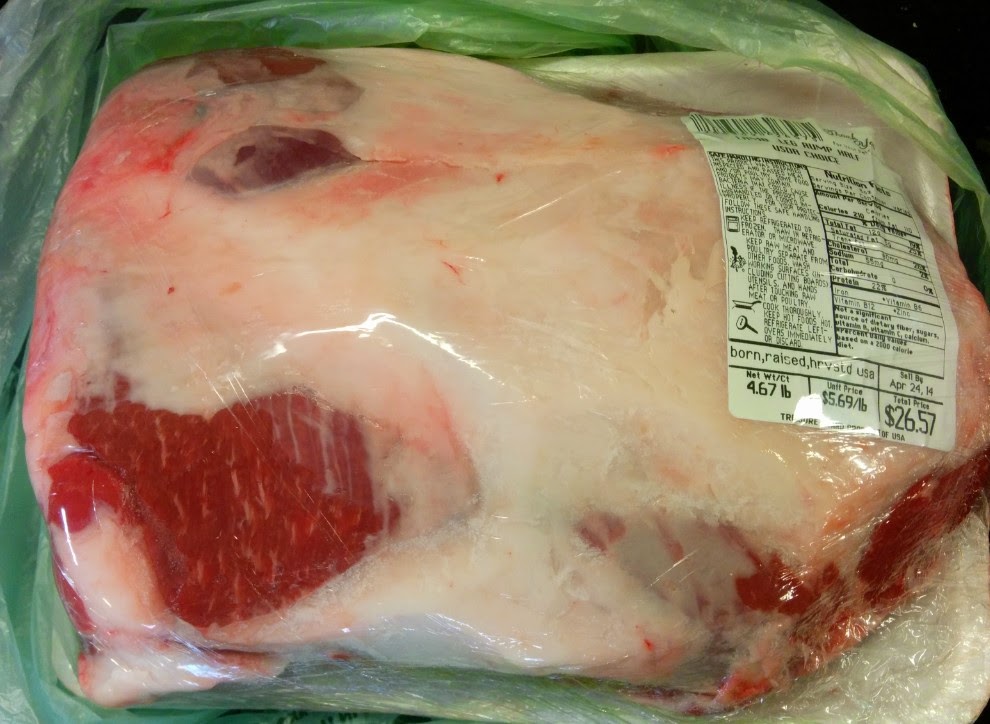
Before we get to the cooking, though, I want to say a quick word about how I trim meat. Look at this leg:


There's a pretty thick fat cap. People tend to either take it all off or leave it all on, but I think that's missing a great opportunity. My goal is to take most of it off, leaving just a thin layer of fat:


It doesn't require super butcher skills. It doesn't have to be pretty. Just make it look something like that, and don't worry, it will be beautiful after it cooks.


Ode to crispy fat. 
Shall I compare thee to a simmer's bay leaf?

No, because that would be silly.  But I will tell you why you should bother to follow my trimming instructions.

You should bother because there's nothing so delicious as browned, crispy fat, and only the outermost surface of the fat will ever get crispy.  Non-crispy fat can be good too, although frankly it doesn't hold a candle to crispy fat, and if you leave a lot of fat on, most Americans will simply cut it all off anyway.  But everyone loves a thin layer of crispy fat.

I mean, that's basically what bacon is.  That's the reason everyone loves bacon, even though it is 50% fat, even though they trim the fat off their steak without a second thought.

Nevertheless, you could conceivably go your whole life without explicitly noticing that crispy fat is the component producing max deliciousness.  So I'm here to beat you over the head with this obvious-in-retrospect fact.  It's easy to verify.  The next time you are trimming your steak at the table, try cutting off the very outer edge of the fat and eating it.  You won't be disappointed.

And, by the way, I think you should mostly ignore recipes that tell you to leave a big fat cap so the meat will be basted while it roasts in the oven.  Basting action can serve a purpose (effectively frying the outside of the roast), but a little goes a long way, and fat takes a long time to render. After the roast is done, you will probably be left with a thick layer of all the unrendered fat that did not baste your meat, so what was the point of it?  If you happen to be surrounded by people who like to eat that stuff, then by all means, leave it on.  Otherwise, you can get 95% of the flavor boost with 5% of the waistline boost by trimming most of it away.


Results.
Anyway, so I bagged the lamb with olive oil, garlic, and thyme:


After cooking, the lamb was quickly seared, to produce this:


I served it with carrots and asparagus, and Israeli couscous which I combined with my egg-lemon soup recipe, which turned out to be a really good idea:


As you can see, the meat is perfectly pink.  There is no visible fat, only a thin crispy layer working its invisible magic on the look and taste of the final product.


To Victory!
And now I would like to make a very special announcement: Victory!  As we know, lamb is an acquired taste, and one that most Americans have not acquired.  Less than one pound of lamb is consumed for every 100 pounds of chicken in the US.  And there was a time when Catherine too did not like lamb. She would eat it, but only begrudgingly.  I have worked hard to change that, because lamb is one of my very favorite meats.

Recent months have seen considerable progress.  First, she started to complain when I would cook lamb for myself and chicken for her.  Then I started to get actual positive reactions.  And with this dish, I got a genuine rave review!

Wolf me down, and your journey towards the lamb side will be complete! 

Furthermore, I have since replicated my results with a lamb shoulder roast (forthcoming), so it wasn't just a fluke.  It's safe to say that Catherine now loves lamb, just like me and many of my fellow Vongsas.  Huzzah!  It's only fitting, now that she's a Vongsa too :)